Startups · Todays Trend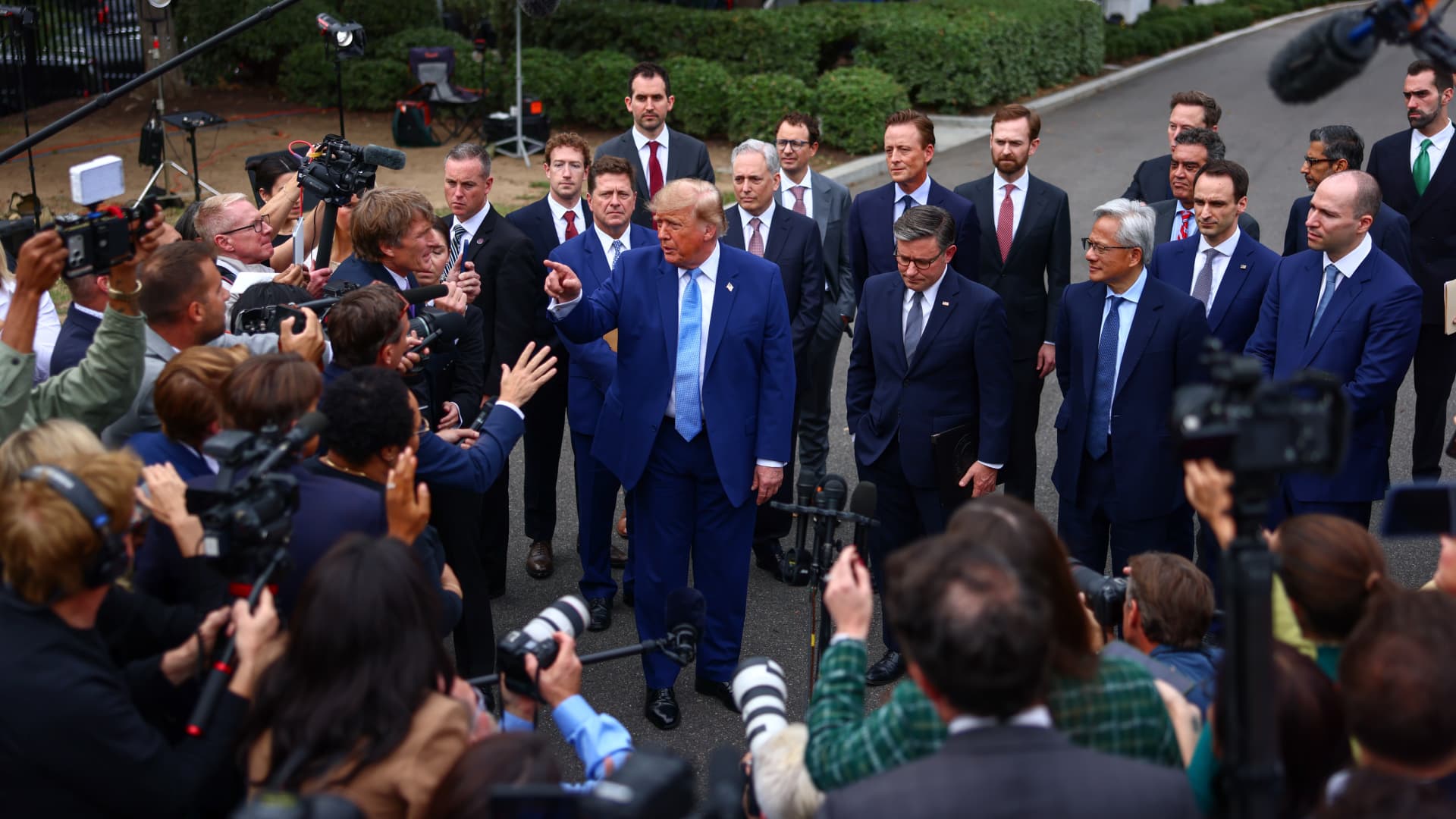
US President Donald Trump, from center left, US House Speaker Mike Johnson, a Republican from Louisiana, and Jensen Huang, chief executive officer of Nvidia Corp., speak to members of the media following a meeting with tech executives on artificial intelligence at the White House in Washington, DC, US, on Tuesday, Sept. 29, 2026. Tierney L. Cross | The Washington Post | Bloomberg | Getty Images Hello, this is Hui Jie writing to you from Singapore.
Welcome to another edition of CNBC's Daily Open. Rock band Green Day once asked to be woken up when September ends, but with the developments in the AI world and markets keeping a close eye on Treasury yields, investors probably won't need much help keeping awake this year. What you need to know today When a document is signed in government circles, a question that usually comes up is whether it is legally binding or not.
Now, U.S. President Donald Trump has introduced an ambiguous middle ground: "morally binding." Trump said Tuesday that he signed such a document with tech leaders following a luncheon at the White House, as calls to slow down the development of frontier models continue in the U.S. Some of these leaders include Nvidia chief Jensen Huang, Tesla and SpaceX CEO Elon Musk and Meta's Mark Zuckerberg .
To be sure, the document is voluntary. House Speaker Mike Johnson said that it was a statement of principles that are "voluntary on behalf of the industry." and said the White House will guide industry development. Trump told reporters that he's "seeing tremendous self-policing" and that the administration is considering building a 10-person committee to oversee the AI industry.
Earlier in the day, Trump maintained that the government would not halt AI development and promoted self-regulation, although the president also said that "we automatically have regulation with the Department of Justice, the FBI, all of that." In another rebranding attempt, Trump also ordered all executive branch departments and agencies to use the term "super intelligence" instead of artificial intelligence . The order states that the new term must be used by all departments and agencies in official correspondence, public communications, policy and other documents in the executive branch, and "Artificial Intelligence" and "AI" will no longer be acknowledged. Despite Trump claiming that the name has been changed along with the tech titans who had convened for a lunch meeting with him, the tech executives appeared to sign a separate, two-page document unrelated to the name change.
Connecting OpenAI's dots Elsewhere in the AI world, OpenAI held its annual DevDay developer conference on Tuesday, where the AI company (or should we call it a super intelligence company now?) announced a slew of new products and features . One of these was Dots, new "always-on" AI agents that are designed to help users complete a range of tasks. Separately, CNBC also confirmed that a potential new funding round for the company of around $30 billion could be in the works.
This year's DevDay comes as OpenAI has been under intense pressure to address mounting safety concerns , with the company holding back its latest Astra model over safety concerns. Canada's import bans Washington may be taking a light touch approach to the AI industry, but the administration is pulling no punches with Canada. The White House banned imports of some Canadian vehicles, dairy and alcohol products on Tuesday.
The products are estimated to total around $19.9 billion of Canadian imports by the American Action Forum . The import ban, announced earlier this month by the Trump administration, is the latest step in a war of words — and tit-for-tat tariffs — between the U.S. and Canada. Trump said he expects a "fair deal" with Canada in the coming weeks, but Ottawa has said that it will sign an agreement only when it is in Canada's interests.
"We're not waiting by the phone," Canadian Trade Minister Dominic LeBlanc said. Markets wrestle with Treasury yields U.S. markets fell on Tuesday following another rise in Treasury yields to fresh multiyear highs, with all three indexes posting back to back losing sessions. The 30-year Treasury bond yield climbed to a high above 5.6% to reach a level not seen since June 2002.
The benchmark 10-year Treasury note yield topped 5.29% at its session high. Investors will be watching Wednesday’s personal consumption expenditures report to discern some more clarity on the Fed's future moves. Economists expect both headline and core PCE prices to have increased 0.3% in August.
On an annual basis, headline inflation is forecast to remain at 3.7%, with core inflation holding at 3.3% — both well above the Federal Reserve’s 2% target. — Lim Hui Jie And finally... Clients said to be sticking with Morgan Stanley even after leaked deal pipeline Morgan Stanley's accidental disclosure of confidential information about its Asia deal pipeline has raised questions over the potential impact on its client relationships. The disclosure may have carried competitive implications, but that does not necessarily mean Morgan Stanley will lose mandates as a result, according to people familiar with the matter, raising questions over how much lasting damage it could do to the bank's dealmaking business.
For instance, one buy-side source currently working with Morgan Stanley on deals said their firm isn't reconsidering its mandates with the bank. — Jenny Lee
Source: CNBC